

The McNulty Memo (Monthly Musings on Faith and Public Life)
Editor’s note: This is the sixth in a series of articles looking at Christian faith in the public square. This is part of the Institute’s Center for Faith & Public Life initiative.
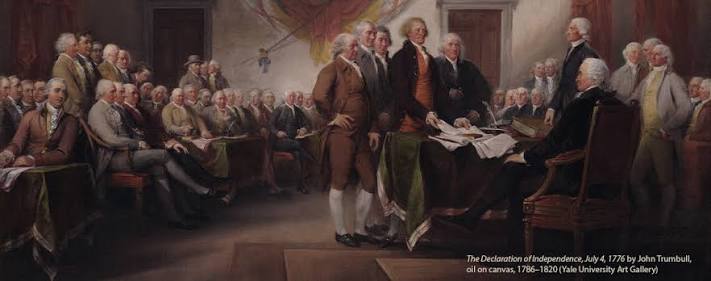
Everyone has a worldview—you, me, and those 56 patriots who signed the Declaration of Independence 250 years ago. I first encountered this concept half a century ago as a freshman at Grove City College. While America celebrated the bicentennial of the Declaration of Independence in 1976, I was enrolled in a required course entitled “Religio-Philosophical Dimensions of Life” taught by Dr. Andrew Hoffecker. Years later, Hoffecker coedited a two-volume collection of papers titled Building a Christian World View. Much of it deriving from the content of the “Rel-Phil” course. In the preface, Hoffecker writes:
Underlying all that we think, say, or do are basic assumptions that form what we call a “world view.” A person’s world view is the collection of his presuppositions or convictions about reality, which represent his total outlook on life. Nobody is without such fundamental beliefs, and yet many people go through life unaware of their presuppositions.
Simply put, a worldview is the lens through which we see and understand everything.
With attention turned to the Declaration on the occasion of its semiquincentennial anniversary, it’s an ideal opportunity to consider the presuppositions of the men who pledged their lives, fortunes, and sacred honor in producing this monumental document. How did they see the world? Any appeal in this current cultural moment to the Declaration’s “self-evident” truths should at a minimum acknowledge the religious convictions at the core of its historic message.
There are at least four unmistakable Christian presuppositions affirmed in the Declaration:
1. God is the purposeful and benevolent creator of mankind. Jefferson’s famous reference to self-evident truths, which he originally called “sacred and undeniable,” that “all Men are created equal” and “endowed by their Creator with certain unalienable Rights,” reflects a creation theology. God is acknowledged to be both the creator and benefactor of the world. Human beings are made in His image and thereby endowed with heavenly gifts and attributes. No alternative theory of secular materialism offers the same unshakable support for human equality and basic rights.
As a former college president, I have a special appreciation for the word “endowed.” Academic institutions strive to build large endowments to advance their strategic vision through the kindness and generosity of like-minded donors. Similarly, God gave us eternal purpose. Life, liberty, and happiness are the corpus of His endowing goodness.
2. God’s moral will is revealed in nature. The Declaration appeals to “the Laws of Nature and Nature’s God” in justifying the new country’s rightful place among the nations of the earth. In making their case for independence, the Founders saw the necessity of aligning their cause with God’s law. Anything less risked degrading their actions to mere political machinations.
3. Human beings are accountable to God for their actions. The Signers understood God to be the “supreme judge of the World” to whom they must appeal “for the Rectitude of our Intentions.” In other words, God has established moral absolutes, abiding standards of right and wrong, that are revealed in nature and govern the affairs of mankind. The rightness of our actions must conform to an objective standard. And God sits in judgment over man’s behavior and the conduct of nations.
4. God providentially reigns over the affairs of this world. The Declaration concludes with this awe-inspiring sentence: “And for the support of this Declaration, with a firm Reliance on the Protection of divine Providence, we mutually pledge to each other our Lives, our Fortunes, and our sacred Honor.” In the summer of 1776, the success of the Revolution was far from certain. New York City fell to the British invaders in August. The 56 Signers placed their names on what was potentially a death warrant. Thus, their statement of trust in God was no formality. They were indeed relying on the protection of His kind providence. And in doing so, they were affirming a particular worldview in which God brings all things to pass for the good of believers according to the counsel of His will.
To what extent do Americans know these presuppositions? Much of what we are hearing and reading regarding America’s 250th celebration focuses on political power and freedoms addressed in the Constitution rather than the Declaration. In the days ahead, numerous voices will coopt the purpose of America’s celebration for the advancement of their political agendas. Many will reveal a shocking lack of familiarity with the actual content of the Declaration.
My hope is that the vast majority of our fellow citizens will recognize our singular opportunity to remember, revere, and renew the central ideas that launched the new nation into existence. We can remember the Founders’ vision and heroism grounded in God-honoring convictions. We can revere God’s providential beneficence in sustaining our experiment in democracy for two and a half centuries. And we can renew our commitment to a worldview that sees our liberty as being freedom “to” and not freedom “from” a shared moral calling that was described 11 years later in the Constitution as the formation of “a more perfect union.”