

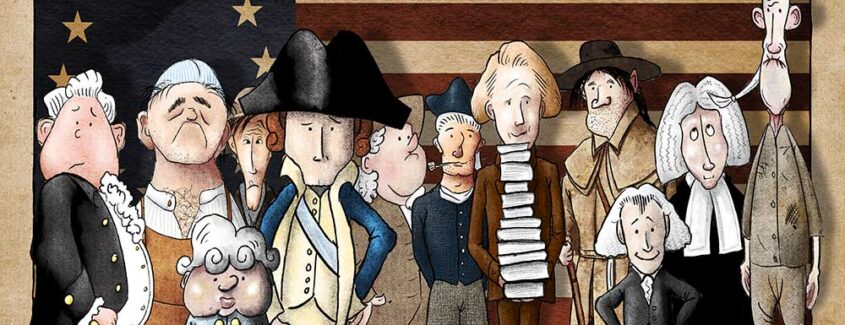
A battle rages today over the nature of the faith of America’s Founders. This debate plays a central role in the heated dispute over whether the United States was founded as a distinctively Christian nation, an essentially secular one, or one built upon a variety of philosophical premises and over how to interpret the First Amendment.
Describing their faith is challenging because the Founders are a large, diverse group and because people’s faith can be evaluated in various ways. Does the Founders’ faith depend primarily on their stated convictions and beliefs or more on their actions including their church attendance and leadership positions, devotional activities (prayer and Bible study), involvement in parachurch activities, and conduct?
Historians and journalists, including Edwin Gaustad, Steven Waldman, Richard Hughes, Steven Keillor, and Brooke Allen, argue that the worldview of most Founders was strongly shaped by Deism and the tenets of the Enlightenment. Historian Frank Lambert, for example, argues that the impact of Deism and the Enlightenment on the founding of the American republic and the relationship between church and state “can hardly be overstated.”
Deism, which was popular in Western intellectual circles in the 17th and 18th centuries, asserts that God created the world but does not intervene in it. Once the process has begun, God is uninvolved. Therefore, Deists do not believe in God’s providence or in prayer. They also deny the authority of Scripture and reject many central Christian doctrines including Christ’s deity, atonement for sin, and resurrection.
Christian popular writers such as Peter Marshall Jr., John Eidsmoe, Tim LaHaye, William Federer, David Barton strongly disagree. They maintain that the United States had a distinctly Christian founding and that almost all the Founders were devout, orthodox Christians whose biblical convictions shaped their political philosophy.
The truth lies in the middle. Many of the Founders were indeed orthodox Christians whose faith was deep, meaningful, and very important to their understanding of how the American republic should be constituted. Others were not trinitarian Christians, but their political philosophy was significantly affected by the Bible and Christian theologians.
Almost every Founder, like almost all Americans in 1776, identified as Christian. They included Presbyterians, Congregationalists, Lutherans, Anglicans/Episcopalians, Quakers, Catholics, and Unitarians. Many Founders were probably sincere, devout Christians, but this is difficult to prove. Even if a Founder belonged to and regularly attended a church, he may have done so because it was a social expectation. Substantial evidence indicates, however, that numerous Founders embraced orthodox Christian tenets.
The Founders were also influenced by the Anglo–American political–legal tradition and their own political experience, and like all humans, they were motivated to varying degrees by self, class, or state interests. Their views were also shaped by Lockean liberalism, classical republicanism, and the Scottish Enlightenment, but Christianity had a profound impact on many Founders.
Many who played leading roles in the Continental Congress and the devising of the Constitution were devout Christians, as evident in their church attendance, involvement in prayer and Bible reading, belief in God’s direction of earthly affairs, and conduct. The nation’s orthodox Christian Founders included Samuel Adams, who served as the governor of Massachusetts; Patrick Henry, a Virginia governor best known for his “give me liberty or give me death” speech; John Jay, the first chief justice of the Supreme Court and a governor of New York; Roger Sherman, a member of the Continental Congress and the U.S. Senate from Connecticut; John Witherspoon, the president of Princeton; Elias Boudinot, a president of the Continental Congress and a U.S. Senator from New Jersey; Boston merchant and Massachusetts Governor John Hancock; physician Benjamin Rush, a member of the Continental Congress; George Mason, a planter and politician who authored the 1776 Virginia Declaration of Rights; Quaker John Dickinson, the president of both Delaware and Pennsylvania; Catholic Charles Carroll, a U.S. Senator from Maryland; and Abigail Adams, the wife of the second president and an advocate for women’s rights.
The claim of some scholars that most Founders were strident secularists or devoted Deists is patently false. These scholars typically cite Thomas Jefferson, Benjamin Franklin, James Madison, George Washington, Thomas Paine, and John Adams to make their case that most Founders were Deists. While some of these men might have been Unitarians rather than Christians in that they did not view Jesus as divine, they all believed that God directed the universe and in personal prayer. Arguably, the only two Deists among the Founders were Ethan Allen who penned, Reason the Only Oracle of Man (1785), and his mentor Thomas Young.
The faith of the Founders played an important role in establishing the American republic. The Founders created a government and society that were hospitable both to Christians and practitioners of other religions. Almost all the hundreds of men who attended the federal Constitutional Convention of 1787, participated in the state ratification conventions, and were elected to the first federal Congress, called themselves Christians, and many of them were influenced by orthodox Christian ideas in important ways.
The Founders asserted that God is the source of all authority and that humans have dignity because they are created in God’s image. As a result, people possess the faculty of reason and a capacity for moral discernment.
The Founders firmly believed that God established moral standards, that legislation should be enacted in accordance with these standards, and that divine laws superseded human laws.
The Founders’ belief in human sinfulness led them to design a constitutional order that separates powers and provides checks and balances. The Founders argued that democracy could survive only if citizens restrained their passions, obeyed shared moral convictions, and strove to act virtuously.
Their faith led many Founders to strongly protect religious liberty, and the Founders insisted that Christianity was much more likely to thrive when it was voluntary.
The Founders did not seek to establish a Christian nation. But they did devise a nation whose governmental structure and operations in many ways is consistent with Judeo-Christian presuppositions and principles. So, as we celebrate our nation’s 250th birthday, let’s be thankful for these extraordinary Founders and their commitment or at least openness to Judeo-Christian principles and values that have greatly benefitted our nation.