

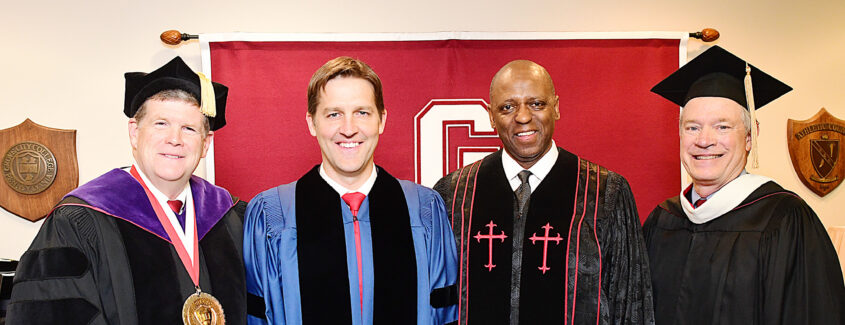
Former Senator Ben Sasse, Grove City College’s 2019 commencement speaker, is dying from pancreatic cancer. But I doubt this is news for anyone reading this article. His inspiring testimony has become a social media sensation with millions of viewers captivated by his many television and podcast interviews. He has been featured on “60 Minutes,” CNN, and a New York Times podcast, just to name a few.
Ben is offering keen insights on many important topics, but most importantly, he is showing the world what it means to die well. It’s also an opportunity to reflect on a rare aspect of faith and public life. Last February, roughly two months removed from his terminal diagnosis, Ben sat down with Peter Robinson of the Hoover Institution. This interview quickly circulated to an expanding audience and launched this remarkable occurrence of public suffering. Questioned about his apparent peace in such dire circumstances, he explained:
I’m with Paul when he says to live is Christ, to die is gain. Obviously, death is a wicked thief. I don’t want it to happen. But we’re mortals and it seems like it’s not sophisticated or modern or naive to pretend we’re not mortals. It’s true. And so you gotta grapple with big questions. And this is not news to me that I had numbered days. It just became a more precise number. We all have numbered days.
Similarly, with Scott Pelley on “60 Minutes,” he put it this way:
Death is wicked. Death is evil. Death is not how it’s supposed to be. And me getting a cancer diagnosis, again, is pretty small on the grand scheme of things. But it’s a touch of grace because it forces me to tell the truth. And the lie I wanna tell myself is that I’m the center of everything. And I’m gonna be around forever. And I can work harder, and store up enough, that I can atone for my own brokenness. I can’t. And so, I hate cancer. But I’m also grateful for it. I tell a lot more truth to myself than I used to … when I thought I was super omni-competent and interesting.
I first met Ben, 54, when he was in his mid-20s, and long before he became an assistant secretary at the Department of Health and Human Services, a small college president, a twice-elected Nebraska senator, and then president of the University of Florida. His intellect, energy, and communication skills are off the charts. Yet I have had the privilege of knowing him as a thoughtful and sincere Christian friend devoted to advancing Christ’s kingdom in this world.
No one would be faulting Ben Sasse if he was secluded at home with his family while he endures the misery of cancer treatment. His face is covered in rashes and scabs, a horrible side-effect from an experimental chemotherapy drug, which in his case is showing great promise. Most of us would avoid even being seen in public, let alone appearing on national television. But not Ben. He just warmly offers his interviewer a nerdy (his word) science lesson on why his skin cells aren’t reproducing and then dives into an enthralling wide-ranging conversation.
Reflecting on the prospect of death, Ben is unafraid. When politely invited to express doubts about his eternal destiny or gripe about the fairness of God’s actions, Ben instantly declines. “There are no maverick molecules in the universe,” he says with a peaceful smile. He even shares that while he wishes he didn’t have pancreatic cancer, he would never want to go back to his pre-cancer prayer life, an extraordinary insight he gained from the deceased New York City pastor Tim Keller. Ben is now laser-focused on redeeming the time (Ephesians 5:17). Not surprisingly, viewers are amazed by his winsome testimony. Has any public figure ever done this before?
Maybe it’s just me, but I’m fascinated by the timing on all of this. It seems like the world is turning upside down. The old rules are being tossed aside at a frightening pace. A Nazi tattoo is no longer unacceptable for a political candidate. Rich white people are voting for socialists who condemn rich white people. What used to be disqualifying ideas (e.g., defund police, antisemitism, open borders, and even cancelling Thanksgiving) have significant support. Women’s professional basketball, obvious beneficiaries of Title IX, has aligned itself with the trans agenda. America has pulverized Iran’s military capability, but the terrorist regime seems as radical and militant as ever. Extreme profanity is now commonplace. Daily use of pot reportedly exceeds alcohol and cigarettes. And meanwhile, AI is taking over our lives and the nation’s workforce has disappeared. Nothing seems to make sense anymore. It’s all very disorienting.
And then there’s Ben Sasse talking about looking forward to life after death because of what Jesus accomplished on the cross. CNN titled its recent interview with the words “Ben Sasse is Going Home: Lessons on Life and Death.” Like a ray of sunshine breaking through thick dark clouds, Ben’s voice is being heard at an especially stressful time in our current, postmodern cultural upheaval. I suspect his message of grace and hope is for me and countless others like breathing through an oxygen mask in this suffocating cultural moment.
The apostle Peter encourages us to always be ready to respond “to anyone who asks you for a reason for the hope that is in you.” (1 Pet 3:15) Ben says that learning his days are numbered “is not news to me.” By God’s grace, he and his family were ready for this. I saw this in my own son who lost his life to cancer. The psalmist says that a godly person “is not afraid of bad news; his heart is firm, trusting in the Lord. His heart is steady; he will not be afraid, until he looks in triumph on his adversaries (cancer!).” (Ps 112:7-8)
Christians in public life must be ready to respond faithfully to the unfolding providence of God. Very few will be called to suffer publicly and demonstrate what it means to die well. But leadership offers no greater opportunity. And as we are witnessing with Ben Sasse’s courageous story, people will be drawn to “a touch of grace” and what is truly true.