

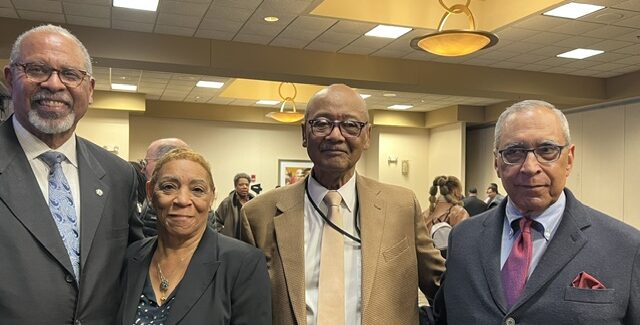
Picture, L to R: J. Kenneth Blackwell, Rosa Blackwell, Robert Woodson, Shelby Steel. (Photo: Courtesy of J. Kenneth Blackwell.)
Editor’s note: Bob Woodson was the keynote speaker at our first IFF (formerly the Center for Vision & Values) conference in April 2005, which was a 40-year retrospective on LBJ’s War on Poverty.
About the author: The Honorable J. Kenneth Blackwell has served as Mayor of Cincinnati, Ohio Secretary of State, U.S. ambassador to the United Nations Human Rights Commission, and as an Undersecretary at the U.S. Department of Housing and Urban Development. He is also President of the Council for National Policy. Blackwell is a former Trustee of Grove City College.
This article first appeared at The American Spectator.
Bob Woodson, founder of the Woodson Center and the 1776 Unites project, died at 89.
Bob grew up fatherless in a Philadelphia housing project, raised by a single mother after his father died young, dropped out of high school, and joined the Air Force at 17. He earned his GED in the service, went on to study math at Cheyney University, then earned a master’s in social work from the University of Pennsylvania.
He marched with the NAACP. He ran the National Urban League’s criminal justice division.
He marched with Dr. Martin Luther King, Jr. He got arrested for it.
He believed in both organizations until they became Democrat Party fronts with no connection to their original cause.
The break came over forced busing. In the 1960s, the civil rights mainstream pushed hard for busing Black children across town to integrate schools. Woodson said no. He watched Black children get pulled out of schools staffed by highly educated Black teachers and sent to inferior schools in white neighborhoods.
The integration was real. The improvement was not.
He got called a segregationist for saying it.
His answer: “I said, just because we have a common issue doesn’t mean we have a common purpose. Their reasons for opposing school busing and mine were different. If Hitler likes classical music, and I like it, am I supposed to stop liking it?”
He eventually summed up what those organizations had become in four words: “Bitchin’, begging, and busing.”
He left. In the 1970s, he worked for the NAACP on community development, for the National Urban League on criminal justice in New York City, and for the conservative American Enterprise Institute on neighborhood revitalization in Washington.
He found them all ineffective … left, right, and government alike.
“The civil rights movement was beginning to morph into a race grievance industry. They asked which problems are fundable, not which ones are solvable.”
He saved his sharpest words for Al Sharpton and Jesse Jackson. Keep in mind what Bob Woodson built with a $25,000 grant. Then consider that Al Sharpton built a career showing up after the cameras did.
“There’s nothing worse than self-flagellating guilty white people and rich, angry Black people who profit off the misery of their people. What Sharpton and some of those are doing is worse than bigotry. It’s treason. It’s moral treason against their own people.”
“The only time you hear from them is when a white police officer kills a Black person, which happens maybe 20 or 21 times a year. But 6,000 Blacks are killed each year by other Blacks. Their message is that Black lives only matter when taken by someone white.”
He called them “race hucksters” who had no interest in solving problems because solving problems would put them out of business. “My worry is that the money and resources will go to the same racial grievance groups, the same members of what I call the poverty Pentagon. They’ll give it to Sharpton and the others to do what they’ve been doing for decades. What doesn’t work. What in fact is making things worse.”
So he went and built something that worked.
In 1981, with a $25,000 grant and two decades of hard-won experience, he founded the Woodson Center as an alternative to left-wing groups, right-wing groups, and government aid programs alike.
His bet was simple. The people closest to a problem are best positioned to solve it, not government agencies, not think tanks, not organizations that flew in, wrote reports, and flew home.
The people who woke up every morning inside the problem.
His ideas crossed every political line. Vernon Jordan, president of the National Urban League, backed him. So did Democratic Congressman John Conyers, chairman of the House Subcommittee on Crime. Woodson testified before that panel and urged Black empowerment as the answer to crime.
Not more government.
Not more programs.
More trust in the people already living in those communities.
By the 1980s, President Ronald Reagan was listening too. Woodson and Reagan spoke highly of each other publicly, met in the Oval Office, and worked together on policies aimed at Black communities.
Their shared conviction was that enterprise zones and empowerment zones, areas where tax incentives and deregulation could unlock private investment in struggling neighborhoods, were more powerful than any federal aid program.
Woodson sat on the board of the American Association of Enterprise Zones and worked closely with HUD Secretary Jack Kemp, whose partnership with Woodson became one of the most consequential alliances in the history of urban policy.
Over four decades, the Woodson Center brought training and support to more than 2,600 leaders of faith-based and community organizations in 39 states, helping them secure more than ten times the funding the center itself spent.
In 1997, after a 12-year-old boy was murdered by feuding gangs in a southeast Washington, D.C. housing project, Woodson brokered a peace, holding the meetings at his own office.
He wrote hundreds of articles and several books on youth crime and urban policy, including The Triumphs of Joseph in 1998.
He lectured at colleges and community centers across the country. He never stopped calling it as he saw it.
“In the past 50 years, $22 trillion has been spent on poverty programs. Seventy percent goes not to the poor but to those who serve poor people.”
“When the suffering of a people becomes a fundraising hook, the incentive shifts from solving problems to sustaining grievances.”
In 2020, he launched 1776 Unites as a direct answer to the 1619 Project, telling the stories of Black Americans who built schools, businesses, and institutions against every odd.
People who refused to be defined by what had been done to them. He wanted to plant seeds of possibility in young minds and drive out the curse of fatalism.
He had 40 years of results to back it up.
A few weeks ago, at 89 years old, he published his final essay.
He called it “Wake Up, Black America. Excellence Is Our Inheritance.” He was still in the fight until the very end.
Rosa and I are keeping the Woodson family in our prayers. We were blessed to know him.
Rest in peace, Bob.